What is a heat network?
Heat networks are vital to making net zero a reality in the UK. In high density urban areas, they are often the lowest cost, low carbon heating option. This is because they offer a communal solution that can provide heat to a range of homes and businesses by capturing or generating heat locally. Heat networks include city-wide district heating as well as smaller scale heat networks using ground source heat pumps and shared ground loops. All of these technologies have a role to play in decarbonising heat in the UK whether that’s at scale across our densely populated cities or in more localised areas.
By driving forward new low carbon technologies like heat networks, we can cut the use of fossil fuels for heating our homes and shield households from oil and gas price rises that are being pushed up by pressures on global energy markets.
Through the Heat Network Transformation Programme (HNTP), the government is working with industry and local authorities, and investing over half a billion pounds in funds and programmes, to develop new heat networks and improve existing ones.
The role of heat networks
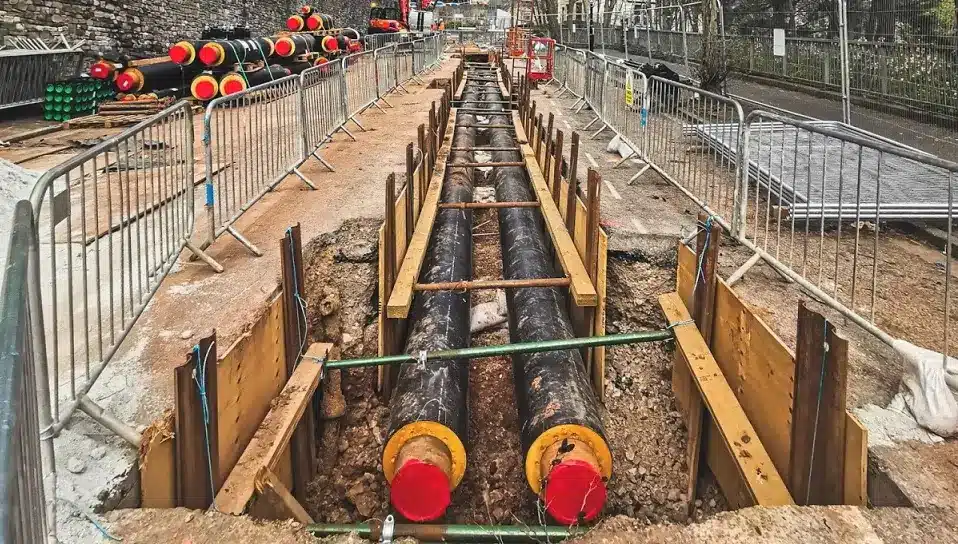
Heat networks distribute heat or cooling from a central source or sources and deliver it to a variety of different customers such as public buildings, shops, offices, hospitals, universities and homes. By supplying multiple buildings, they avoid the need for individual boilers or electric heaters in every building.
Heat networks are also uniquely able to use local sources of low carbon heat which would otherwise go to waste. This recoverable heat could be from factories, the ground or even from rivers.
Available support
The government is providing targeted support to grow the heat networks sector and ensure that more homes and businesses in England and Wales can access low carbon heating and hot water. Support includes:
- funding for feasibility studies
- capital investment
- procuring external finance
- improving the performance of existing networks
Feasibility and detailed project development
The Heat Networks Delivery Unit provides grant funding and guidance through the early stages of project development.
Commercialisation and construction
The Green Heat Network Fund (GHNF) is a capital grant fund that supports the development of low carbon heat networks for organisations in the public, private, and third sectors in England.
Heat network operation
Heat training grant
If you work in heat networks, you could get up to £500 towards the cost of heat network training.
Training providers can also apply to offer the grant to trainees.
Energy Bill support
Heat network customers get support with their energy bills through the Energy Bills Discount Scheme. All heat suppliers with domestic customers need to apply to the scheme.
The Heat Network Efficiency Scheme (HNES)
The Heat Network Efficiency Scheme (HNES) provides grant funding to support performance improvements to existing / operational district heating and communal heating projects.
To underpin the scheme, the government has published series of short guidance videos that set out a range of practical steps operators can take to improve the performance of heat networks.
- Apply for the Heat Network Efficiency Scheme (HNES) Round 12
- Heat networks optimisation: guidance to help operators improve performance
Regulation, zoning and broader policy
Through the Heat Network Transformation Programme, the government is enacting legislation and developing policies and regulations to ensure that heat networks can contribute towards reaching net zero.
This includes improving consumer protection, creating the conditions to grow the market, lowering emissions, improving the performance of heat networks, and building up skills in the sector to encourage investment and jobs growth.
- Products Characteristics Database
- Heat networks regulation: technical standards
- Heat network zoning
- Heat networks regulation: consumer protection
- Regulations: heat networks (metering and billing)
- Conservation of fuel and power: Approved Document L
- Energy Security Bill
- Recovering the costs of heat networks regulation
- Standard Assessment Procedure (SAP 10.2): proposals for updates for heat networks
Resources: tools, data, research and reports
The government has developed a range of tools, data and research reports that can assist in the various aspects of heat network operation from initial planning and development through to long-term operation and expansion.
This includes resources such as a template financial model, regular reports on projects in development and the heat networks pipeline documents which contain overviews of projects and upcoming procurements that are currently being supported by government.
These Heat networks pipelines provide the market with an overview of planning, projects and procurement that Heat Networks Delivery Unit (HNDU), Green Heat Networks Fund (GHNF) and its predecessor, the Heat Networks Investment Project (HNIP) are working with.
Heat networks: guidance for developers and the supply chain
Heat network template financial model: for use by financial modellers to input values from a techno-economic model and evaluate key financial aspects of a prospective heat network opportunity.
Tools, data, research and reports
- Heat Network (Metering and Billing) Regulations 2014: registered heat networks
- Sewer heat recovery: exclusion zone guidance methodology
- Heat Networks registered under the Heat Network (Metering and Billing) Regulations
- Heat network consumer and operator survey (2022)
- Opportunity areas for district heating networks in the UK: second National Comprehensive Assessment
- International heat networks: market frameworks review
- Energy Trends: March 2018, special feature article – Experimental statistics on heat networks